Meta Andromeda: How AI Is Changing Facebook & Instagram Advertising
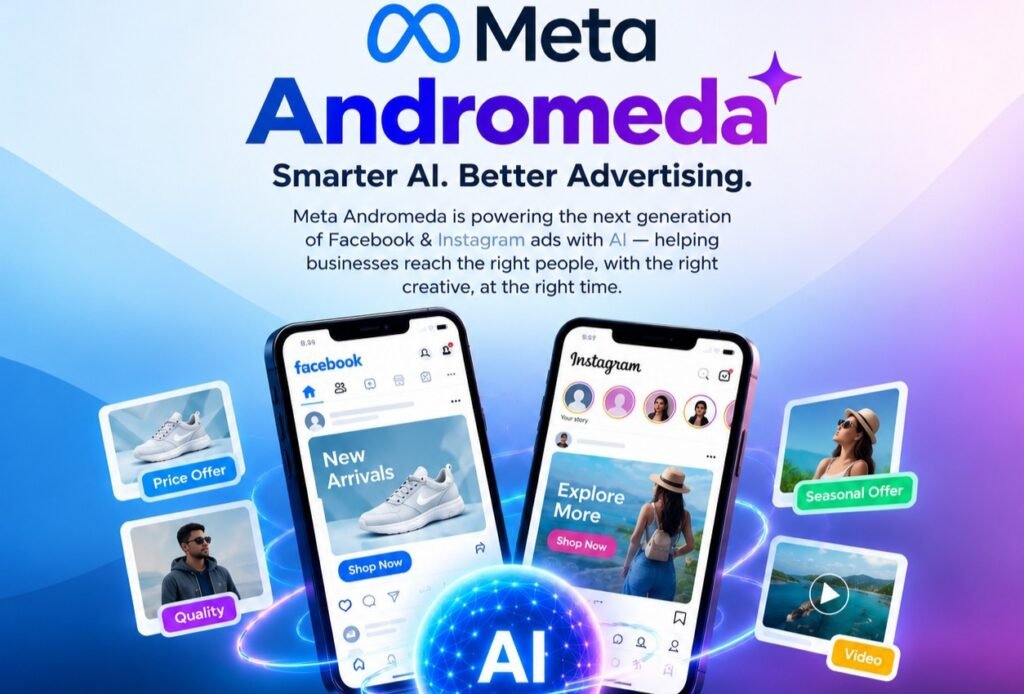
However, Facebook and Instagram advertising have seen some drastic changes during the recent period of time. The process that was previously highly reliant on audience targeting, campaign settings, and optimizing each ad individually is now being facilitated through artificial intelligence technology. In particular, one of the notable innovations in terms of AI is Meta Andromeda, which is Meta’s advanced advertising retrieval and ranking system. This innovation will be especially relevant for digital marketers and companies, since it will become yet another way of selecting, personalizing, and distributing advertisements. With the help of AI, Meta Andromeda will be able not just to match the advertisement with a chosen audience but to see whether certain creative is more relevant for a specific user at a specific moment in time. Nowadays, the company is making the AI algorithms more complicated and scalable to enhance the procedure of ad selection for various audiences. Thus, what is Meta Andromeda, and how does it impact Facebook and Instagram advertising? What Is Meta Andromeda? Meta Andromeda is a next-generation AI-powered system designed to improve the process of finding and selecting relevant advertisements for users across Meta’s platforms. Traditional advertising systems often had to process a relatively limited number of possible advertisements for each user. As advertisers started producing more variations of images, videos, headlines, formats, and messages, the number of possible combinations became much larger. This created a challenge for an advertising platform. Meta needed a system capable of handling a huge number of creative possibilities while quickly identifying the ads that could be most relevant to each individual user. Andromeda is part of Meta’s answer to that challenge. Unlike the approach of treating each and every user in an audience segment the same way, systems powered by AI are capable of taking into consideration far more information about which advertisement to display. This means the future of Meta Ads is moving away from simply asking: “Who should see this ad?” and increasingly toward: “Which version of this ad is most relevant to this person right now?” Changes In Meta Advertising From AI The application of AI has become significant in various stages of advertising on Facebook and Instagram, including selection of target audience, ranking of the ad, ad creation, campaign optimization, and ad performance prediction. Meta has incorporated the technology in various advertising products like Advantage+. According to the company, the AI-based advertising technologies help in matching the advertisements with people most likely to undertake the action in an efficient manner. Meta Andromeda is a continuation of this AI-based strategy in terms of improvement of the system that fetches and ranks ads. 1. Smarter Ad Selection Another major difference that can be noticed in AI-driven advertising is the ability to select advertisements for specific audiences. Consider an apparel brand making 20 different advertisements for one product. Some advertise the offer through price, some through quality, others via video, and yet others for seasonal offers. Traditionally, marketing professionals had to manually decide to which audiences each version would be targeted. AI-driven advertising would allow to see which one is likely to resonate with different users. Meta Andromeda helps support this AI-driven approach by identifying which creative may be more relevant to different users. For instance, users who regularly engage with fashion Reels will react in a different way than those who have engaged with discount content earlier. The idea here is to make the process of advertising more personalized without having to manually develop campaigns for each audience group. 2. Creative Variety Becomes More Important Meta Andromeda also highlights an important change for advertisers: creative diversity matters. In the past, marketers often spent significant time building extremely detailed audience targeting strategies. Today, Meta’s AI systems can handle more of the audience discovery and delivery process. This means advertisers can benefit from providing the system with multiple high-quality creative options. Different creatives can communicate the same product in different ways: Product-focused images Short-form videos Customer testimonials Educational information Problem-and-solution ads Lifestyle creatives Promotional offers UGC-style videos The AI system can then help identify which creative is more suitable for different people. Therefore, instead of creating one advertisement and expecting it to work for everyone, marketers should develop a creative testing system. 3. Personalization Is Becoming More Advanced Personalization is among the major benefits provided by AI for digital advertising. People differ from each other in terms of preferences, behavior, interests, and intentions to buy certain products and services. It is unlikely that showing the same ad to all people will bring the best results. The company Meta uses machine learning algorithms to personalize the user experience concerning advertisements. Furthermore, Meta Andromeda supports the broader use of AI in advertising by helping the system understand which advertisements may be more relevant to different users. The company has announced some updates in 2026 that will help the company to use the data about the business and personalize its content and advertisements according to the settings selected by the user. It means that the significance of personalization in the advertising environment of Meta is becoming higher. Therefore, it is necessary for advertisers to pay more attention to creating the content. 4. Less Manual Targeting, More AI Optimization They could choose interests, behavior, demographics, location, custom audiences, lookalike audiences, and various other targeting categories. Artificial intelligence is shifting the balance of marketer’s involvement. Using automated tools like Advantage+, marketers can provide Meta with all necessary information regarding their business goal, creatives, budget, and conversion triggers, and leave the optimization process to artificial intelligence. This doesn’t imply that targeting is becoming unnecessary. On the contrary, this changes the nature of marketers’ job. Meta Andromeda further supports this AI-driven shift in advertising. Instead of spending most of their time on tuning different combinations of targeting options, marketers now have more time to focus on customers, generate new ideas, work on landing pages, and analyze results of their business. 5. AI Can Help Improve Advertising Performance The ultimate goal of AI-powered advertising is performance.